Skip to content
SOL

SOL

🔗Home

🔗About Us

🔗Contact & Subscribe

🔗Services

🔗Terms of Use

🔗Thoughts on Security

🔗 Start a project
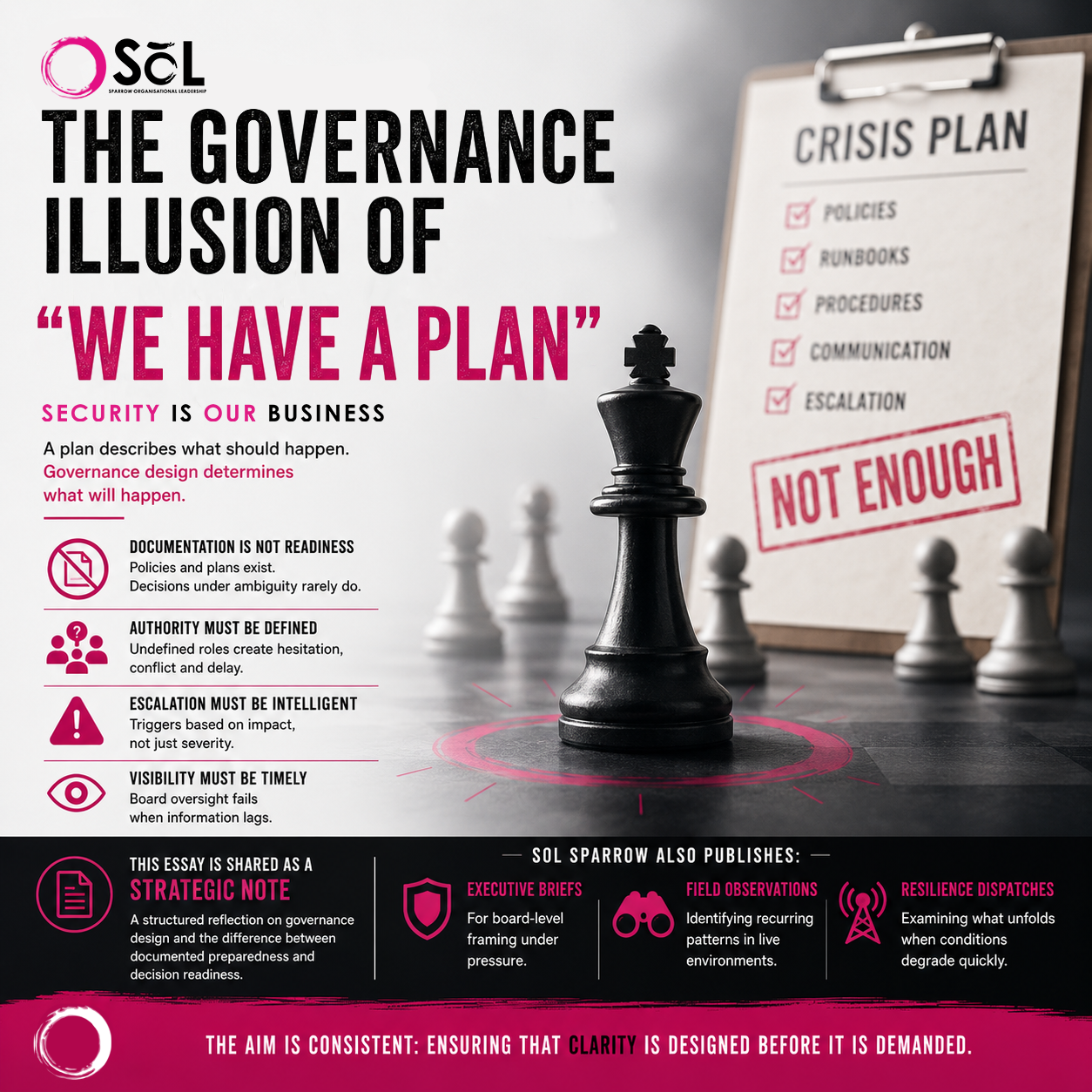
  • The Governance Illusion of “We Have a Plan”

    Many organisations believe they are prepared because documentation exists.

    Policies are written.
    Runbooks are drafted.
    Crisis manuals are stored.

    Preparation is assumed.

    Yet plans rarely describe how decisions will actually be made under ambiguity.

    Governance maturity is not measured by the existence of a plan. It is measured by the integration of authority, information flow, and escalation logic when conditions degrade.

    Common governance gaps include:

    • Undefined authority during cross-functional conflict.
    • Escalation triggers based on severity scoring rather than business impact.
    • Board visibility lag during fast-moving events.

    A plan describes what should happen.

    Governance design determines what will happen.

    The illusion of readiness often dissolves when ambiguity increases and information conflicts. Without pre-defined decision architecture, leadership reverts to improvisation.

    Preparedness is not documentation.
    It is rehearsed clarity.

    SOL

    This essay is shared as a Strategic Note — a structured reflection on governance design and the difference between documented preparedness and decision readiness.

    SOL Sparrow also publishes:
    • Executive Briefs for board-level framing under pressure.
    • Field Observations identifying recurring patterns in live environments.
    • Resilience Dispatches examining what unfolds when conditions degrade quickly.

    The aim is consistent: ensuring that clarity is designed before it is demanded.

    Share this:

    • Share on X (Opens in new window) X
    • Share on Facebook (Opens in new window) Facebook
    Like Loading…
    SOL

    ← Back

    Thank you for your response. ✨

    Rating(required)

    Sparrow Organisational Leadership


      Discover more from SOL

      Subscribe to get the latest posts sent to your email.

    • Why Most Risk Registers Create False Confidence

      Risk registers provide visibility. They do not provide resilience.

      They catalogue threats.
      They score likelihood and impact.
      They assign owners.

      They create the appearance of control.

      But risk rarely materialises according to its documented pathway.

      Live incidents expose interaction effects:

      • A cyber event disrupts suppliers.
      • Supplier disruption affects regulatory obligations.
      • Regulatory delay impacts reputation.
      • Reputational pressure accelerates executive decisions.

      Static registers struggle with dynamic interdependence.

      The danger is not that risk registers are wrong. It is that they are treated as comprehensive.

      Confidence derived from categorisation can obscure systemic vulnerability.

      Resilience requires understanding how risks compound under pressure — not simply how they are ranked in advance.

      SOL

      This piece forms part of SOL Sparrow’s Strategic Note series — exploring how risk, assurance, and interdependence function beyond static documentation.

      Additional formats include:
      • Executive Briefs supporting board oversight during consequential events.
      • Field Observations reflecting operational patterns across complex systems.
      • Resilience Dispatches capturing insight from moments where pressure exposes structural gaps.

      The purpose is not to catalogue risk, but to examine how it behaves under stress.

      Share this:

      • Share on X (Opens in new window) X
      • Share on Facebook (Opens in new window) Facebook
      Like Loading…
      SOL

      ← Back

      Thank you for your response. ✨

      Rating(required)

      Sparrow Organisational Leadership


        Discover more from SOL

        Subscribe to get the latest posts sent to your email.

      • When the Shift Starts, Judgment Shrinks

        The first hours of a serious operational disruption do not test strategy. They test decision architecture.

        This is not a failure of intent. It is a failure of timing. In live environments, the system moves faster than leadership can assemble a shared picture.

        • Operations see delivery degradation.
        • Safety sees exposure.
        • HR sees fatigue and workforce risk.
        • Legal sees duty‑of‑care boundaries.
        • The board sees reputational and regulatory consequence.
        • The CEO sees uncertainty.

        Each view is valid.

        The problem is that they arrive in parallel rather than in sequence.

        Most organisations are designed to operate, not to decide under ambiguity. They build vertical efficiency and expect horizontal alignment to appear when pressure rises. It rarely does. Functional incident response guidance emphasises that response activities must be integrated across the organisation, not limited to a single function, precisely because fragmented response leads to inconsistent decisions and delayed action.

        Operational resilience frameworks make the same point from another angle: escalation pathways must be defined and tested, and boards must receive timely reporting of significant issues.

        The core requirement is not more reporting. It is shared interpretation before
        decisions are irreversible.

        This is why judgment shrinks. Leaders are forced to decide when the operational picture is still forming. They try to resolve ambiguity by asking for more data, but data arrives as fragments, not synthesis.
        The decision window contracts. What was a strategic choice becomes a forced choice. The organisation begins to “move” without actually being aligned.

        The mature organisations do not avoid this. They design for it.

        They clarify decision ownership before the incident. They pre‑agree escalation triggers based on business impact, not technical severity. They rehearse cross‑functional briefings that integrate people, safety, operations, and reputational risk into one view. They accept that incomplete information is not a defect; it is the default condition under pressure.

        Operational resilience guidance is explicit: escalation mechanisms must keep senior management and the board informed of significant issues and risk limit breaches, and reporting should be current and forward‑looking rather than
        retrospective.

        The absence of this architecture is why strategy stops. Not because leaders forget strategy, but because their system for converting strategy into decisions is not designed to handle compressed time, fragmented signals, and ambiguous responsibility.

        The shift does not reveal who has the best strategy. It reveals who has designed the most credible decision pathways.

        SOL

        This essay is part of SOL Sparrow’s Executive Brief series — board‑level framing on governance, resilience, and decision architecture under pressure.

        SOL Sparrow also shares:
        • Strategic Notes on governance and assurance architecture.
        • Field Observations identifying patterns in live operational settings.
        • Resilience Dispatches examining how systems behave when pressure tests design.
        The purpose is consistent: strengthening clarity before consequences unfold.

        Share this:

        • Share on X (Opens in new window) X
        • Share on Facebook (Opens in new window) Facebook
        Like Loading…
        SOL

        ← Back

        Thank you for your response. ✨

        Rating(required)

        Sparrow Organisational Leadership


          Discover more from SOL

          Subscribe to get the latest posts sent to your email.

        • What Calm Leadership Looks Like in a Live Crisis

          Calm leadership is often described as composure.

          In practice, it is structure.

          During live incidents, teams do not need optimism. They need stability of interpretation. They need leaders who reduce cognitive noise, not amplify it.

          Calm leaders do three things consistently:

          • They slow the emotional tempo without slowing operational tempo.
          • They distinguish between signal and speculation.
          • They protect decision clarity from reactive escalation.

          In high-pressure environments, tone spreads faster than information. Anxiety multiplies assumptions. Confidence multiplies coherence.

          Calm is not personality. It is discipline.

          It is the ability to say:
          “We do not yet know. Here is what we do know. Here is the next decision.”

          That containment protects both performance and credibility.

          Organisations often invest heavily in incident response plans. Far fewer invest in rehearsing executive composure.

          But in live crisis environments, leadership tone becomes infrastructure.

          SOL

          This piece is published as a Field Observation — part of SOL Sparrow’s reflections on patterns consistently seen in complex, high-pressure environments.

          Related formats include:
          • Strategic Notes examining governance and assurance design.
          • Executive Briefs providing board-level framing for consequential decisions.
          • Resilience Dispatches offering focused insight from moments where ambiguity accelerates.

          Each format is designed to strengthen disciplined leadership when stability becomes operational infrastructure.

          Share this:

          • Share on X (Opens in new window) X
          • Share on Facebook (Opens in new window) Facebook
          Like Loading…
          SOL

          ← Back

          Thank you for your response. ✨

          Rating(required)

          Sparrow Organisational Leadership


            Discover more from SOL

            Subscribe to get the latest posts sent to your email.

          • Fragmentation Is a Governance Design Flaw

            Fragmentation is often described as a communication issue.

            It is not.

            It is a governance design choice.

            Over time, organisations build capability silos for efficiency:
            – Cybersecurity strengthens controls.
            – Risk builds frameworks.
            – Legal manages exposure.
            – Operations optimise delivery.

            Each function matures independently.

            What rarely matures is integration logic.

            During normal conditions, fragmentation is tolerable. Under pressure, it becomes visible.

            Parallel reporting lines compete for attention.
            Metrics lack a common risk translation.
            Escalation pathways overlap or contradict.

            The incident itself may be manageable.

            The coordination strain is not.

            Governance maturity is not the sophistication of individual functions. It is the strength of connective tissue between them.

            Integration is rarely glamorous work.
            But without it, speed converts into friction.

            Fragmentation is not accidental.

            It is designed — or left undesigned.

            SOL

            This article forms part of SOL Sparrow’s Strategic Note series — structured reflections on how governance and integration design shape performance under stress.

            Related formats include:
            • Executive Briefs for board and senior leadership framing.
            • Field Observations highlighting patterns observed in live environments.
            • Resilience Dispatches examining decision-making when conditions accelerate.

            Design determines behaviour long before crisis reveals it.

            Share this:

            • Share on X (Opens in new window) X
            • Share on Facebook (Opens in new window) Facebook
            Like Loading…
            SOL

            ← Back

            Thank you for your response. ✨

            Rating(required)

            Sparrow Organisational Leadership


              Discover more from SOL

              Subscribe to get the latest posts sent to your email.

            • When the Incident Starts, Strategy Stops

              When a serious incident begins, organisations often assume their strategy will guide them.

              It rarely does.

              The first hours of a cyber breach, operational disruption, or geopolitical shock do not test strategic ambition. They test decision architecture.

              Security sees indicators.
              IT sees systems degrading.
              Legal sees exposure.
              Communications sees reputational risk.
              The Board sees uncertainty.

              What they rarely see is a shared operational picture.

              This is the moment where clarity collapses.

              Most failures in live incidents are not technical. They are structural. Parallel reporting lines compete. Severity is interpreted differently across functions. Escalation thresholds are ambiguous. Ownership blurs.

              The result is not chaos — it is hesitation.

              Executives are forced to make high-impact decisions without consolidated assurance. Strategy pauses while alignment catches up.

              The organisations that navigate these moments well have already answered three questions before pressure arrives:

              1. Who holds decision authority when information is incomplete?
              2. What triggers escalation across silos?
              3. How is assurance integrated before it reaches the board?

              Strategy does not fail in crisis.
              Decision design does.

              SOL

              This piece is published as an Executive Brief — part of SOL Sparrow’s board-level framing on governance, resilience, and decision architecture under pressure.

              Other formats include:
              • Strategic Notes — structured reflections on governance and assurance design.
              • Field Observations — recurring patterns identified in live operational environments.
              • Resilience Dispatches — focused insight from moments where speed and ambiguity intersect.

              The purpose is consistent: strengthening clarity before consequences unfold.

              Share this:

              • Share on X (Opens in new window) X
              • Share on Facebook (Opens in new window) Facebook
              Like Loading…
              SOL

              ← Back

              Thank you for your response. ✨

              Rating(required)

              Sparrow Organisational Leadership


                Discover more from SOL

                Subscribe to get the latest posts sent to your email.

              • Decision-Making Collapse in Cyber

                Most organisations do not fail during cyber incidents because of technical gaps.

                They fail because decision-making clarity collapses.

                When an incident begins, information fragments immediately.

                Security analyses indicators.
                IT diagnoses system instability.
                Legal assesses exposure.
                Communications anticipates reputation impact.
                Executives attempt to understand scale.

                Each function is competent.
                What is missing is integration.

                The early phase of a cyber incident is rarely chaotic. It is structured confusion — multiple accurate perspectives without a shared frame.

                Severity scoring differs.
                Escalation thresholds are interpreted differently.
                Language becomes imprecise.

                The result is hesitation at the moment speed matters most.

                Executives are asked to make consequential decisions while the operational picture is still assembling. They are not choosing between good and bad options. They are choosing between incomplete interpretations.

                This is not a technical failure.

                It is a decision design gap.

                Resilient organisations do three things before an incident occurs:

                1. Define who holds authority when information conflicts.
                2. Pre-agree escalation triggers based on business impact, not technical severity.
                3. Rehearse executive briefings that integrate cross-functional signals.

                Clarity under pressure does not emerge spontaneously.

                It is designed.

                SOL

                This piece is shared as a Resilience Dispatch — focused insight from moments where speed, ambiguity, and consequence intersect.

                SOL Sparrow also publishes:
                • Strategic Notes examining governance and assurance design.
                • Executive Briefs providing board-level framing under pressure.
                • Field Observations identifying recurring patterns in complex operational environments.

                The aim is to clarify decision architecture before pressure compresses it.

                Share this:

                • Share on X (Opens in new window) X
                • Share on Facebook (Opens in new window) Facebook
                Like Loading…
                SOL

                ← Back

                Thank you for your response. ✨

                Rating(required)

                Sparrow Organisational Leadership


                  Discover more from SOL

                  Subscribe to get the latest posts sent to your email.

                • 2026 Cybersecurity Outlook: Threats, Trends and Why a Strong Security Culture Is Your Best Defense

                  Cybersecurity isn’t just about technology — it’s about people, decisions, and culture.

                  We don’t sell fear.
                  We don’t over-engineer solutions.
                  We help people think clearly — and act deliberately — under pressure.

                  2026 is shaping up to be a watershed year. As cyber threats grow more automated, intelligent, and multi-dimensional, organisations that cultivate a strong security culture — not just buy tools — will be better prepared to weather the shocks ahead.

                  Here’s a pragmatic look at the biggest trends we already see in motion, what they mean for organisations large and small, and why culture must be at the center of your security strategy.


                  1. AI Is No Longer Optional — It’s the Battlefield Itself

                  Experts agree that artificial intelligence has moved from an optional capability to the core arena where cyber attackers and defenders meet. AI is amplifying both sides of cyber operations:

                  • Attackers are using AI to automate phishing, probing and exploit creation at scale.
                  • AI-generated vulnerabilities and autonomous agents are enabling more sophisticated breach tactics.
                  • Deepfakes — voice, video and identity spoofing — are eroding trust in authentication and human verification.

                  What this means: security teams must think in terms of augmented human–AI cooperation, not technology silos. Strong culture reinforces critical thinking about where AI is used responsibly and where it’s monitored and governed.


                  2. Identity Is the New Perimeter

                  Gone are the days when firewalls and isolated networks defined your defensive boundary. In 2026, identity — human and machine — is the attack surface:

                  • Credential theft, token misuse and identity abuse are dominating breach vectors.
                  • Traditional passwords are giving way to phishing-resistant MFA and passkeys, yet adoption lag remains a risk factor.

                  A culture that normalises secure behavior — unique credentials, MFA (Multi-factor Authentication) use, least-privilege access and continuous validation — directly reduces exposure.


                  3. Ransomware and Expanded Threat Horizons

                  Ransomware continues to evolve, expanding beyond historically “critical sectors” into retail, logistics, manufacturing, and more — with substantial operational impact when systems go dark.

                  But technology alone won’t stop it — preparedness and resilient response does. That means:

                  • Clear incident response plans
                  • Practice drills
                  • Cross-team alignment when things go wrong

                  Cultural readiness makes these actions second nature instead of crisis-induced chaos.


                  4. Supply Chain and Systemic Risk

                  Interconnected ecosystems mean your weakest partner’s security posture can compromise your own. In 2026, systemic supply chain risk — especially in third-party and cloud dependencies — has become a strategic priority.

                  Embedding security awareness across vendors and internal teams reinforces that security extends beyond your own walls — a cultural as much as technical imperative.


                  5. Regulatory and Accountability Pressure Is Rising

                  Regulators, insurers and customers increasingly demand more than certifications — they want proof that security safeguards function effectively, not just exist on paper. Continuous compliance, evidence-based audits, and real-time reporting are becoming baseline expectations.

                  This requires security culture that treats compliance as ongoing discipline, not annual checkbox.


                  6. Human and Organisational Behaviour Still Matter Most

                  Even as technology evolves, attackers still exploit human behavior — social engineering remains a top vector.

                  And the best defenses are cultural:

                  ✔ Engaging security awareness programs (not boring slides)
                  ✔ Realistic simulations aligned with real threats
                  ✔ Leaders who articulate why security matters
                  ✔ Policies reinforced with empathy and relevance

                  As Security Magazine advises, cultivating security culture is not a one-off — it’s a continuous journey of engagement, reinforcement and shared ownership.


                  So How Prepared Are You?

                  If your security plan looks like:

                  • A list of tools you installed
                  • Annual training that everyone skips
                  • A compliance doc filed away

                  …then you’re focused on checkboxes instead of culture.

                  In a landscape where threats adapt faster than technology deployments, foundational behaviors and shared mindset matter more than ever.

                  Culture Is Your Amplifier

                  When everyone, from the CEO to the newest team member, understands:

                  • why security matters
                  • how they influence outcomes
                  • what behaviours protect the organisation

                  — you transform security from an expense into a strategic advantage.

                  That’s what separates organisations that react under pressure from those that act deliberately.


                  Need Help Thinking Clearly and Acting Deliberately?

                  We don’t sell fear.
                  We don’t over-engineer solutions.
                  We help organisations cultivate clarity, build resilience, and navigate uncertainty — with a culture that turns security into a competitive edge.

                  Share this:

                  • Share on X (Opens in new window) X
                  • Share on Facebook (Opens in new window) Facebook
                  Like Loading…
                  SOL

                  ← Back

                  Thank you for your response. ✨

                  Rating(required)

                  Sparrow Organisational Leadership


                    Discover more from SOL

                    Subscribe to get the latest posts sent to your email.

                  • Inherent vs. Residual Risk — Getting Real About What You’re Carrying

                    Inherent vs. Residual Risk — Getting Real About What You’re Carrying

                    As organisations continue to navigate a risk-heavy environment — from ransomware and AI misuse to climate shocks and supply chain instability — understanding your true risk exposure is more critical than ever.

                    You can’t rely on gut feel or assumptions. You need clear, quantifiable insight into the risk landscape tied to your most important business services.

                    The question isn’t “Are we at risk?” — it’s “How much risk are we carrying before and after our controls?”


                    Key Definitions (Without the Jargon)

                    🔹 Inherent risk = The risk level of an activity or service before any controls, mitigation, or safeguards are applied.

                    🔹 Residual risk = What’s left over after your controls are in place — your “lived” risk reality.

                    Understanding both is the foundation of strategic decision-making, resource allocation, and regulatory compliance in 2026.


                    Checklist: Are You Accurately Measuring Risk?

                    Use this quick check to assess the maturity of your current risk assessments:

                    ✅ Have you mapped all your important business services (IBS)?
                    ✅ Do you understand the unmitigated threats to each service — cyber, operational, reputational, third-party?
                    ✅ Are you measuring how well existing controls actually work (not just assuming they do)?
                    ✅ Have you assessed residual risk levels in line with your organisation’s risk appetite?
                    ✅ Are you tracking control gaps or failures that could lead to tolerances being breached?
                    ✅ Are risk owners engaged in reassessments regularly (e.g. post-incident, quarterly, after major changes)?

                    If you’re unclear on any of these, your residual risk profile may be misleading — or dangerously incomplete.


                    Why This Is Strategic, Not Just Technical

                    This isn’t about forms and risk matrices. It’s about aligning operations and resilience:

                    • Inherent risk = your exposure baseline
                    • Residual risk = your resilience reality

                    By properly assessing both, leadership can:

                    • See where critical business services are overexposed;
                    • Justify investment in stronger controls or alternative processes;
                    • Avoid surprises when incidents escalate or regulators come knocking;
                    • Prioritise decisions that keep risk within impact tolerances.

                    Mitigation Measures: What to Do with the Data

                    Once you’ve assessed inherent and residual risk, turn it into action:

                    Validate assumptions

                    • Don’t assume a control is effective — test it through red teaming, scenario exercises, or control audits.

                    Focus on high residual risks

                    • Where inherent risk is high and controls are weak, escalate immediately. This is where disruptions happen.

                    Triage and reallocate resources

                    • Shift resilience, security, or operational spend based on real exposure, not equal distribution.

                    Reassess frequently

                    • Technology, geopolitical threats, and third-party risk change quickly. So should your risk profiles.

                    Integrate into business decisions

                    • Risk assessments should feed into change management, outsourcing, cloud transitions, and digital transformation — not sit in a silo.

                    Closing Thought: Informed Risk Is Manageable Risk

                    Many organisations in 2025 are running with more risk than they realise — not because they’re careless, but because they’re working off outdated or incomplete views.

                    Understanding your inherent and residual risk per business service allows you to move from reactive firefighting to proactive resilience.

                    And in a world that doesn’t slow down for anyone, that’s not just operationally smart — it’s mission-critical.

                    Share this:

                    • Share on X (Opens in new window) X
                    • Share on Facebook (Opens in new window) Facebook
                    Like Loading…
                    SOL

                    ← Back

                    Thank you for your response. ✨

                    Rating(required)

                    Sparrow Organisational Leadership


                      Discover more from SOL

                      Subscribe to get the latest posts sent to your email.

                    • Defining Impact Tolerances — Your Resilience Reality Check

                      Defining Impact Tolerances — Your Resilience Reality Check

                      Why Impact Tolerances Matter going into 2026

                      You can’t protect what you don’t define. In today’s world of multi-layered threats — cyberattacks, infrastructure breakdowns, climate events, geopolitical shocks — it’s no longer enough to focus on continuity plans or recovery speed alone. The real question is:

                      How much disruption can your organisation absorb before customers, regulators, or stakeholders, including your people, are meaningfully harmed?

                      This is the purpose of impact tolerances — the clear, measurable thresholds of disruption your organisation can tolerate without crossing into crisis territory.


                      The 2026 Landscape: Rising Pressure to Know Your Limits

                      Regulatory frameworks are enforcing them:

                      • DORA (EU), UK FCA/PRA, APRA CPS 230 (Australia) — all require organisations to set impact tolerances for important business services.

                      Public expectation is escalating:

                      • Trust in brands depends on transparency and reliability, especially in financial services, healthcare, and digital infrastructure.

                      Most businesses, organisations and networks still operate in the vague:

                      • “Restore ASAP” ≠ a tolerance.
                      • “We’ll know it when we see it” = unacceptable in a compliance review or real-world failure.

                      Checklist: Are Your Impact Tolerances Fit for Purpose?

                      Ask yourself:

                      ✅ Have we clearly identified our important business services?
                      ✅ Do we know what actual harm looks like for each service (financial, reputational, regulatory, customer)?
                      ✅ Have we defined quantifiable limits (e.g. duration of outage, number of customers affected)?
                      ✅ Are tolerances linked to real-world testing (e.g. scenario-based exercises)?
                      ✅ Have we aligned impact tolerances with board and executive risk appetite?
                      ✅ Are they reviewed regularly — not just once and filed away?

                      If any of these are unclear, your tolerances may exist only on paper — not in practice.


                      Strategic Value: More Than a Compliance Checkbox

                      Setting and maintaining impact tolerances helps organisations:

                      • Prioritise resources and recovery plans where the stakes are highest;
                      • Communicate risk and resilience expectations clearly across technical and business units;
                      • Avoid last-minute decision-making in a crisis — when response speed matters most;
                      • Demonstrate assurance to regulators and stakeholders that resilience is more than just a buzzword.

                      Mitigation Measures: From Tolerance to Action

                      Once your tolerances are set, here’s how to make them work:

                      Embed into planning

                      • Use tolerances to guide continuity planning, fallback procedures, and incident response playbooks.

                      Test under stress

                      • Run exercises where tolerances are intentionally breached to see how teams respond and recover.

                      Link to metrics

                      • Build dashboards and KPIs around tolerances to monitor real-time service health.

                      Document decisions

                      • Keep an audit trail of why tolerances were chosen, how they’re maintained, and when they’ve been reviewed or changed.

                      Include third parties

                      • Don’t forget vendors and platforms — their failure may push you over your tolerance line.

                      Closing Thought: Know Your Limits — and Protect Them

                      Impact tolerances are not theoretical. They’re practical guardrails for how much failure your business can survive before you’re in real trouble.

                      In a year defined by compound risks, tightened regulations, and unforgiving headlines, clarity around your risk limits isn’t just a resilience win — it’s a leadership one.

                      Share this:

                      • Share on X (Opens in new window) X
                      • Share on Facebook (Opens in new window) Facebook
                      Like Loading…
                      SOL

                      ← Back

                      Thank you for your response. ✨

                      Rating(required)

                      Sparrow Organisational Leadership


                        Discover more from SOL

                        Subscribe to get the latest posts sent to your email.

                      1 2 3 4
                      Next Page
                      SOL

                      Sparrow Organisational Leadership

                      Quick Links

                      🔗 Home
                      🔗 About Us
                      🔗 Contact
                      🔗 Services
                      🔗 Thoughts on Security

                      Copyright © 2023 SOL – All Rights Reserved.

                      • LinkedIn
                      • WhatsApp
                      • Mail
                      • WordPress

                      🔗 Website Terms

                      🔗 Privacy Policy

                      🔗 Cookie Policy

                      Keep Updated

                      Sign up to receive insights & articles.

                      Sparrow Organisational Leadership

                      Read all posts ↓

                      %d