Risk registers provide visibility. They do not provide resilience.
They catalogue threats.
They score likelihood and impact.
They assign owners.
They create the appearance of control.
But risk rarely materialises according to its documented pathway.
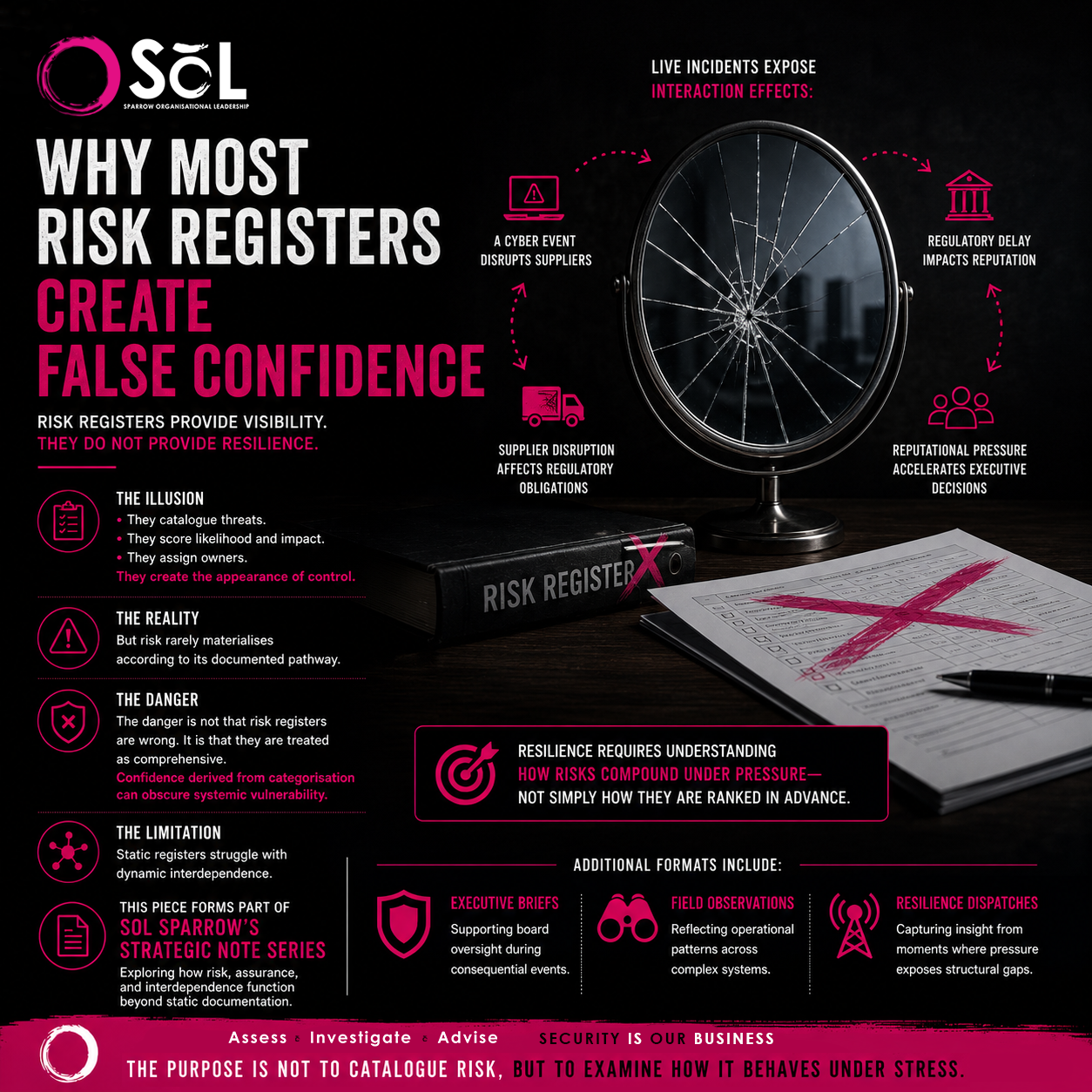
Live incidents expose interaction effects:
- A cyber event disrupts suppliers.
- Supplier disruption affects regulatory obligations.
- Regulatory delay impacts reputation.
- Reputational pressure accelerates executive decisions.
Static registers struggle with dynamic interdependence.
The danger is not that risk registers are wrong. It is that they are treated as comprehensive.
Confidence derived from categorisation can obscure systemic vulnerability.
Resilience requires understanding how risks compound under pressure — not simply how they are ranked in advance.

This piece forms part of SOL Sparrow’s Strategic Note series — exploring how risk, assurance, and interdependence function beyond static documentation.
Additional formats include:
• Executive Briefs supporting board oversight during consequential events.
• Field Observations reflecting operational patterns across complex systems.
• Resilience Dispatches capturing insight from moments where pressure exposes structural gaps.
The purpose is not to catalogue risk, but to examine how it behaves under stress.
