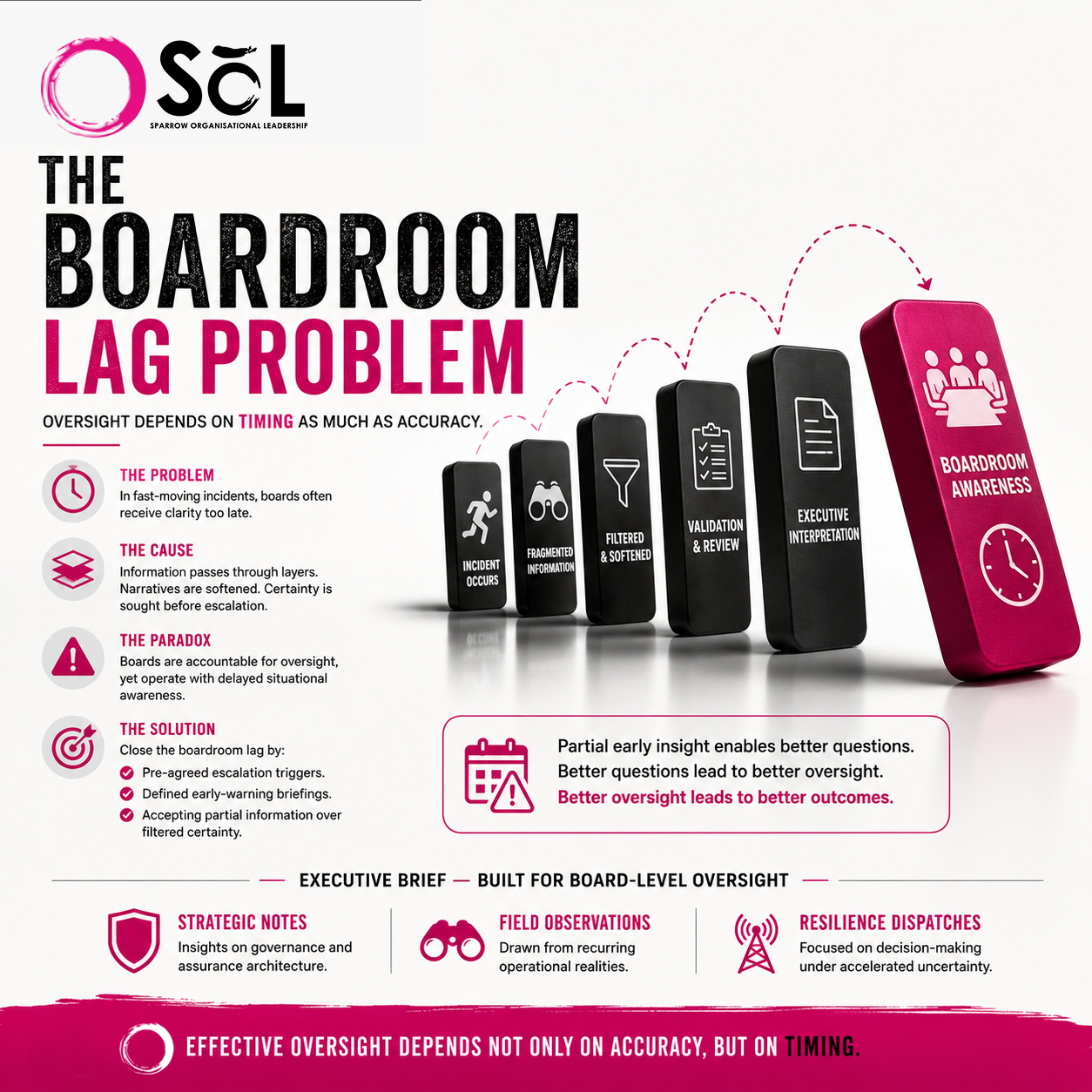
In fast-moving incidents, boards often receive clarity too late.
Operational teams move quickly. Information is partial. Narratives are unstable.
By the time reporting reaches the board, events may already have shifted.
This lag is rarely intentional. It is structural.
Information passes through layers of validation. Interpretations are softened to avoid premature alarm. Executives seek certainty before escalation.
But certainty is rarely available in early crisis stages.
The result is a paradox: Boards are accountable for oversight, yet operate with delayed situational awareness.
Closing the boardroom lag requires:
Pre-agreed escalation triggers.
Defined early-warning briefings.
Acceptance that partial information is better than filtered certainty.
Oversight depends on timing as much as accuracy.
This article is published as an Executive Brief — designed to support board-level oversight where timing, visibility, and accountability intersect.
SOL Sparrow also shares: • Strategic Notes on governance and assurance architecture. • Field Observations drawn from recurring operational realities. • Resilience Dispatches focused on decision-making under accelerated uncertainty.
Effective oversight depends not only on accuracy, but on timing.
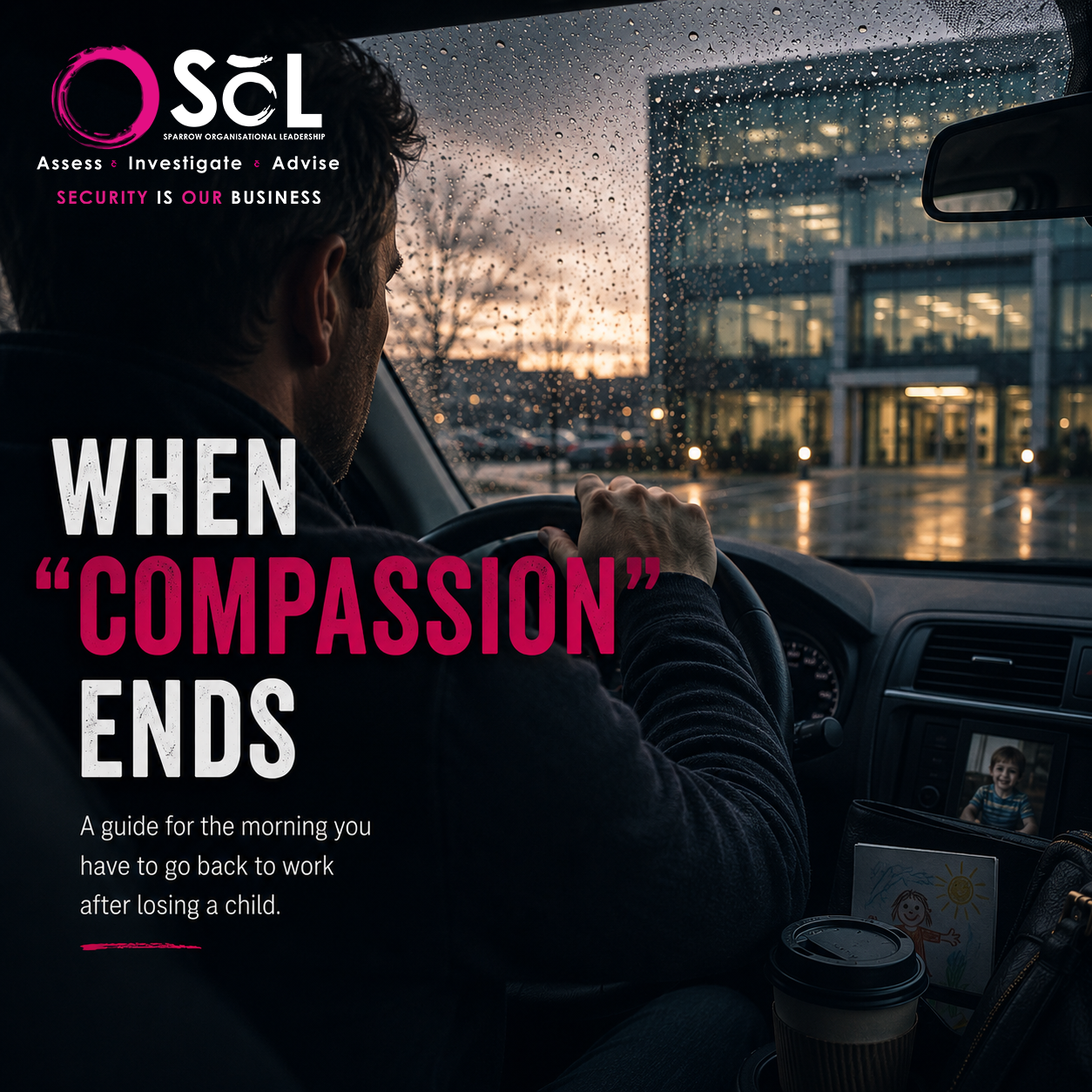
A guide for the morning you have to go back to work after losing a child.
There is a morning that nobody prepares you for.
It isn’t the day you receive the news.
It isn’t the funeral.
It isn’t the days immediately afterwards, when your phone won’t stop ringing, meals appear at your door, flowers arrive from people you haven’t spoken to in years, and everyone tells you to “take all the time you need.”
It’s the morning after all of that.
The morning when life quietly expects you to return.
You wake up because the alarm says you should.
You shower because that’s what you’ve always done.
You make coffee that goes cold.
You put on clothes that suddenly don’t feel like they belong to the same person who wore them before.
Then you drive to work.
You pull into the parking lot.
You switch off the engine.
And you sit.
You stare at the building.
You know you need to walk inside.
You know people will be kind.
You also know they’ll expect you to smile eventually.
To answer emails.
To attend meetings.
To make decisions.
To be “back.”
But you’re not back.
You’re simply here.
If you’re reading this from the driver’s seat of your car because you cannot make yourself open the door…
…stay with me for a few minutes.
This isn’t a guide on how to “move on.”
There is no moving on from losing a child.
There is only learning how to carry a love that no longer has somewhere physical to go.
And that is a very different thing.
When Compassion Ends
Compassion has an unfortunate habit of following a timetable.
The first week, everyone asks how you are.
The second week, people check in.
By the third or fourth week, life begins pulling everyone else back towards normal.
Eventually, someone says the words they probably wish they didn’t have to say.
“Whenever you feel ready…”
Sometimes it’s your employer.
Sometimes it’s your family.
Sometimes it’s your own bank account.
Grief doesn’t end because annual leave does.
Mortgages don’t pause because your world has.
School fees still arrive.
Electricity still needs paying.
Life continues with remarkable indifference.
That doesn’t make you weak if you’re returning before you feel ready.
It makes you human.
The Things Nobody Tells You
Nobody tells you that grief is exhausting.
Not just emotionally.
Physically.
Mentally.
Operationally.
You might read the same email five times.
Forget why you walked into a room.
Lose your train of thought halfway through a sentence.
Stand staring into the office kitchen because you can’t remember why you came in.
Drive home without remembering the journey.
These moments can be frightening.
You might wonder whether something is wrong with you.
There isn’t.
Your brain has survived one of the greatest psychological injuries a human being can experience.
It is trying to keep functioning while carrying a weight that nobody else can see.
One of the greatest human risks after profound loss isn’t a lack of commitment—it’s the invisible cognitive load that grief places on attention, memory, judgement and decision-making.
That weight affects concentration.
Memory.
Decision-making.
Patience.
Energy.
Sleep.
Attention.
None of this means you’re failing.
It means you’re grieving.
There is an important difference.
Bereavement affects far more than our emotions. Research has consistently shown that grief can temporarily affect attention, working memory, concentration, decision-making and executive functioning. Many bereaved people describe “brain fog”—forgetting appointments, rereading emails, losing words mid-sentence or feeling mentally slower than usual. These experiences are recognised features of acute grief and, while distressing, are common responses rather than signs of personal failure.
The death of a child is considered one of the most profound stressors a person can experience. Studies consistently demonstrate that bereaved parents are at significantly higher risk of depression, anxiety, sleep disturbance, physical illness and prolonged psychological distress than parents who have not experienced such a loss.³ While every person’s grief is unique, the impact reaches far beyond emotions—it affects the whole person.
What Your Colleagues May Not Understand
Most people want to help.
They simply don’t know how.
Some won’t mention your child because they’re terrified of upsetting you.
Others will tell you how strong you are.
Some will avoid you altogether because they don’t know what words exist for something so unimaginable.
Very few people mean harm.
Most are simply frightened of getting it wrong.
If someone says something awkward, try to remember that discomfort is often another name for compassion that hasn’t yet learned what to say.
If You’re Sitting in the Car
Don’t ask yourself whether you can get through the rest of the week.
Or the month.
Or the year.
Ask yourself whether you can walk through one door.
That’s all.
One door.
You don’t have to perform today.
You don’t have to be productive today.
You don’t have to prove that you’re recovering.
Today is simply about arriving.
Tomorrow can look after itself.
Trauma-informed care recognises that recovery rarely happens in a straight line. The goal is not to force someone back to previous levels of functioning, but to create enough safety, predictability and support that they can begin rebuilding confidence at their own pace. This principle underpins Psychological First Aid, one of the world’s most widely used evidence-informed approaches to supporting people after major life events.
Practical Things That May Help
Tell one person you trust that today feels difficult.
Write things down instead of trying to remember everything.
Give yourself permission to work more slowly.
Take short breaks before you’re overwhelmed rather than after.
Expect your concentration to drift.
It isn’t laziness.
It’s grief.
Don’t apologise for needing space.
Don’t feel guilty if you laugh.
Don’t feel guilty if you don’t.
Carry a photograph if it helps.
Speak your child’s name if you want to.
You are not leaving them behind by returning to work.
Love doesn’t stop when employment starts again.
What Good Leaders Can Do
If someone returns to work after losing a child, don’t measure their recovery by their productivity.
Don’t expect them to “be themselves again.”
The person who left your workplace is not the same person who has returned.
Instead…
Welcome them quietly.
Ask what they need today—not next month.
Reduce unnecessary pressure where possible.
Allow flexibility.
Accept that grief has no timetable.
Remember important dates.
Most importantly…
Never be afraid to say their child’s name.
For many bereaved parents, the greatest fear isn’t being reminded.
It’s discovering that everyone else has forgotten.
Research consistently shows that supportive leadership, psychological safety and flexibility during major life events improve employee wellbeing, reduce burnout and contribute to healthier long-term return-to-work outcomes. People rarely remember exactly what their manager said during the hardest weeks of their lives—but they almost always remember how they were treated
Why I’m Writing This
I spend my professional life helping people and organisations prepare for crises.
Natural disasters.
Political instability.
Violence.
Critical incidents.
Emergencies.
As a risk manager and psychologist, I’ve learned that not every risk appears on a register.
Some arrive quietly.
Invisible.
A grieving employee sitting in a car outside work.
A parent trying to remember how to answer emails while carrying the impossible.
These aren’t simply wellbeing issues.
They are human risk.
Because when people carry invisible burdens alone, the effects ripple through families, workplaces and communities.
Good organisations understand that resilience isn’t asking someone to return to who they were.
It’s helping them become who they are now.
And It’s about the quiet moment before someone has to walk back into a world that has continued without them.
Before You Open the Door
If you’re reading this before walking into work…
Take one slow breath.
Put both feet on the ground.
Remind yourself of one thing.
You are not walking away from your child.
You are carrying them with you.
Into every meeting.
Every conversation.
Every ordinary Tuesday.
Love doesn’t end because life continues.
And neither should compassion.
If nobody has told you this today…
You’re not alone.
You don’t have to have all the answers.
You don’t have to be okay.
You only have to open one door.
The rest can wait.
There Is No Right Way to Grieve
One of the greatest myths about grief is that it follows a predictable timetable.
It doesn’t.
Some mornings will feel manageable.
Others will bring you back to the very beginning.
Anniversaries.
Birthdays.
School concerts.
Father’s Day.
Mother’s Day.
The smell of shampoo.
A song on the radio.
Grief isn’t a disorder to be cured.
It is love adapting to absence.
If today feels harder than yesterday, it doesn’t mean you’re going backwards.
It simply means today hurts more.
References
1. American Psychological Association. Grief: Coping with the loss of your loved one. Washington DC: APA. Describes common cognitive effects of acute grief including concentration and memory difficulties.
2. National Institute on Aging. Coping with the death of a loved one. Bethesda, MD. Notes that grief commonly affects thinking, memory, sleep, appetite and daily functioning.
3. Margaret Stroebe”,”Bereavement researcher】, Henk Schut. The Dual Process Model of Coping with Bereavement. Death Studies. 1999;23(3):197–224.
4. World Health Organization, War Trauma Foundation, World Vision International. Psychological First Aid: Guide for Field Workers. Geneva: WHO; 2011.
5. National Child Traumatic Stress Network & National Center for PTSD. Psychological First Aid: Field Operations Guide. 2nd edition.
6. Amy Edmondson. The Fearless Organization. Hoboken, NJ: Wiley; 2018. (Foundational work on psychological safety in organisations.)
7. Center for Creative Leadership. Research on compassionate leadership and employee wellbeing.
Every day we are exposed to a relentless stream of bad news. Wars. Political instability. Economic uncertainty. Rising costs of living. Natural disasters. Crime. Social division. The modern world has become an endless feed of risk.
Somewhere along the way, many people have quietly begun adapting to this reality. Not by becoming more resilient, but by becoming smaller.
They travel less.
They take fewer opportunities.
They avoid new experiences.
They withdraw from social activities.
They postpone plans.
They stop taking chances.
They wait for things to become safer. The problem is that safety rarely arrives in the way we expect.
When Protection Becomes Limitation
Fear is a useful survival mechanism. It exists to alert us to danger and encourage protective action. But fear was never designed to operate continuously.
The human nervous system evolved to respond to immediate threats. A predator. A storm. A physical attack.
Today’s threats are different. Most are distant. Some are hypothetical. Many are outside our control. Yet our brains often respond as though they are happening directly to us. The result is a state of chronic vigilance.
People begin making decisions based not on actual risk, but on perceived danger. This is where fear stops protecting us and starts restricting us.
The Hidden Cost of Constant Crisis
Living in a state of prolonged uncertainty changes behaviour.
Research increasingly shows that economic instability, social disruption, political conflict and continuous exposure to negative information can contribute to anxiety, emotional exhaustion and a reduced sense of personal control.
Many people describe feeling stuck. Not because they are incapable. Not because opportunities do not exist. But because uncertainty has become exhausting.
The safest choice begins to feel like doing nothing. Yet inactivity carries risks of its own.
Relationships weaken.
Experiences disappear.
Confidence erodes.
Isolation increases.
The world becomes smaller.
Over time, fear can quietly steal far more from us than the risks we were trying to avoid.
Security Is More Than Physical Safety
At SOL Sparrow, we often discuss security in practical terms. Threats. Risk assessments. Protective measures. Emergency preparedness. These are all important.
But true security is not simply the absence of danger. It is the ability to function despite uncertainty.
A person can live behind locked doors, avoid travel, avoid new experiences and avoid social interaction—and still feel profoundly unsafe.
Conversely, someone can acknowledge risk, prepare appropriately, and continue engaging fully with life.
This is psychological security.
It is the confidence that while uncertainty exists, you possess the skills, awareness and resilience to navigate it.
The Difference Between Recklessness and Living
There is an important distinction between ignoring risk and accepting risk. Good security is never about pretending danger does not exist. It is about understanding risk accurately. Fear often exaggerates probability. Professional risk management does the opposite.
It asks:
What is the actual threat?
How likely is it?
What can I do about it?
What remains outside my control?
These questions transform fear into information. And information creates options. The goal is not to eliminate uncertainty. The goal is to make informed decisions despite it.
Reclaiming Control
One of the most effective responses to uncertainty is action. Not dramatic action. Small action.
Book the trip.
Take the course.
Meet the friend.
Go for the walk.
Attend the event.
Have the difficult conversation.
Do the thing you have been postponing because the world feels unstable. The reality is that the world has always been unstable. Every generation has faced its own crises. What changes is how we respond.
Those who thrive are not the people who eliminate risk. They are the people who refuse to allow fear to dictate every decision.
Living Fully Is a Security Strategy
Security should enable life. Not restrict it. The purpose of preparedness is not to create a smaller world. It is to create confidence.
Confidence to travel.
Confidence to engage.
Confidence to explore.
Confidence to connect.
Confidence to live.
In an age of uncertainty, psychological security may be one of the most valuable forms of protection we can develop. The goal is not to wait for fear to disappear. The goal is to move forward anyway.
Prepared.
Aware.
Resilient.
And fully alive.
This article is published as a Resilience Dispatch — exploring how individuals, leaders and organisations maintain confidence, judgement and effectiveness amid uncertainty, disruption and accelerating change.
SOL Sparrow also shares: • Strategic Notes examining risk, assurance and organisational resilience frameworks. • Field Observations drawn from recurring operational realities and lessons from the ground. • Executive Briefs focused on governance, oversight and strategic decision-making.
Resilience is not the absence of uncertainty. It is the ability to move forward despite it.
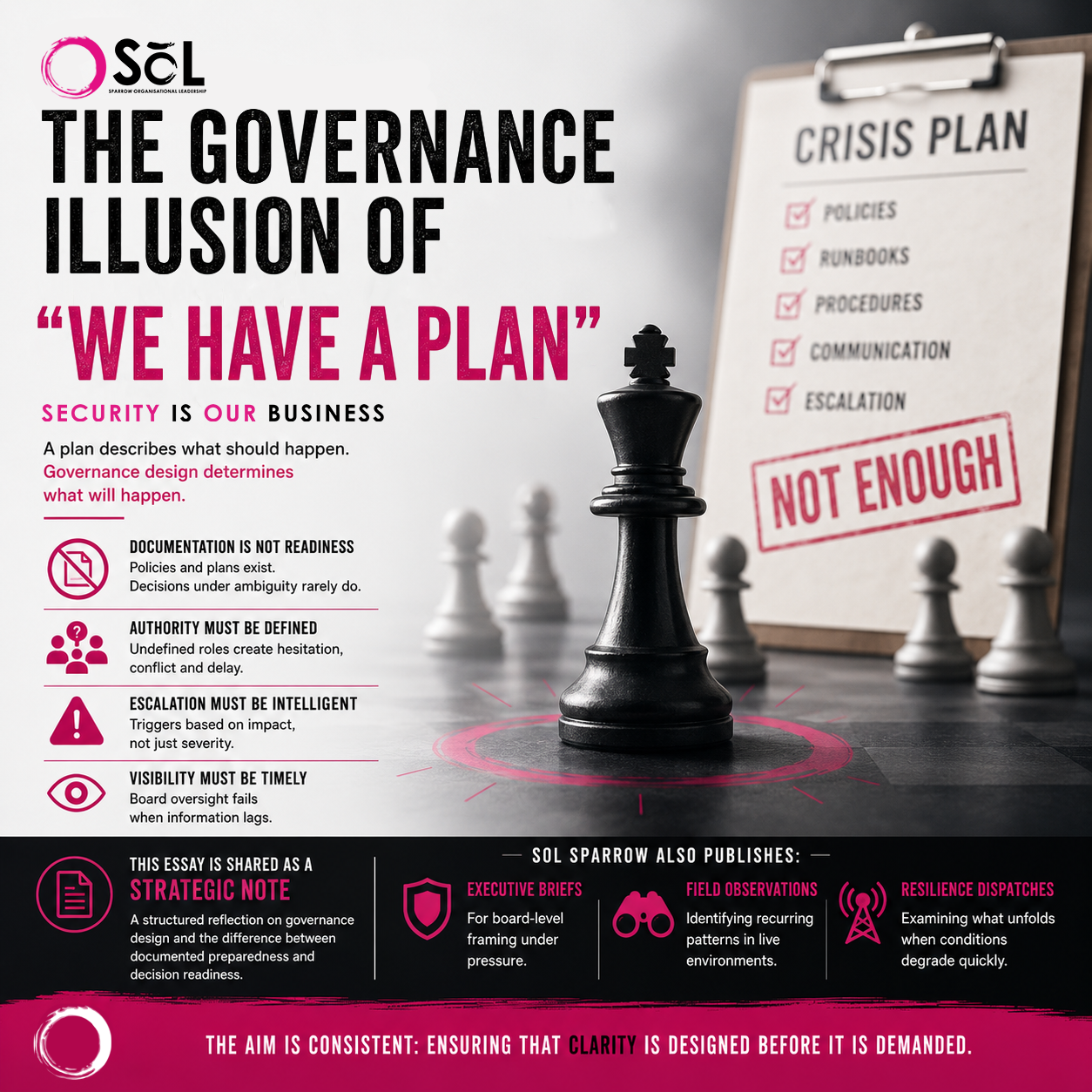
Many organisations believe they are prepared because documentation exists.
Policies are written. Runbooks are drafted. Crisis manuals are stored.
Preparation is assumed.
Yet plans rarely describe how decisions will actually be made under ambiguity.
Governance maturity is not measured by the existence of a plan. It is measured by the integration of authority, information flow, and escalation logic when conditions degrade.
Common governance gaps include:
Undefined authority during cross-functional conflict.
Escalation triggers based on severity scoring rather than business impact.
Board visibility lag during fast-moving events.
A plan describes what should happen.
Governance design determines what will happen.
The illusion of readiness often dissolves when ambiguity increases and information conflicts. Without pre-defined decision architecture, leadership reverts to improvisation.
Preparedness is not documentation. It is rehearsed clarity.
This essay is shared as a Strategic Note — a structured reflection on governance design and the difference between documented preparedness and decision readiness.
SOL Sparrow also publishes: • Executive Briefs for board-level framing under pressure. • Field Observations identifying recurring patterns in live environments. • Resilience Dispatches examining what unfolds when conditions degrade quickly.
The aim is consistent: ensuring that clarity is designed before it is demanded.
Static registers struggle with dynamic interdependence.
The danger is not that risk registers are wrong. It is that they are treated as comprehensive.
Confidence derived from categorisation can obscure systemic vulnerability.
Resilience requires understanding how risks compound under pressure — not simply how they are ranked in advance.
This piece forms part of SOL Sparrow’s Strategic Note series — exploring how risk, assurance, and interdependence function beyond static documentation.
Additional formats include: • Executive Briefs supporting board oversight during consequential events. • Field Observations reflecting operational patterns across complex systems. • Resilience Dispatches capturing insight from moments where pressure exposes structural gaps.
The purpose is not to catalogue risk, but to examine how it behaves under stress.
The first hours of a serious operational disruption do not test strategy. They test decision architecture.
This is not a failure of intent. It is a failure of timing. In live environments, the system moves faster than leadership can assemble a shared picture.
Operations see delivery degradation.
Safety sees exposure.
HR sees fatigue and workforce risk.
Legal sees duty‑of‑care boundaries.
The board sees reputational and regulatory consequence.
The CEO sees uncertainty.
Each view is valid.
The problem is that they arrive in parallel rather than in sequence.
Most organisations are designed to operate, not to decide under ambiguity. They build vertical efficiency and expect horizontal alignment to appear when pressure rises. It rarely does. Functional incident response guidance emphasises that response activities must be integrated across the organisation, not limited to a single function, precisely because fragmented response leads to inconsistent decisions and delayed action.
Operational resilience frameworks make the same point from another angle: escalation pathways must be defined and tested, and boards must receive timely reporting of significant issues.
The core requirement is not more reporting. It is shared interpretation before decisions are irreversible.
This is why judgment shrinks. Leaders are forced to decide when the operational picture is still forming. They try to resolve ambiguity by asking for more data, but data arrives as fragments, not synthesis. The decision window contracts. What was a strategic choice becomes a forced choice. The organisation begins to “move” without actually being aligned.
The mature organisations do not avoid this. They design for it.
They clarify decision ownership before the incident. They pre‑agree escalation triggers based on business impact, not technical severity. They rehearse cross‑functional briefings that integrate people, safety, operations, and reputational risk into one view. They accept that incomplete information is not a defect; it is the default condition under pressure.
Operational resilience guidance is explicit: escalation mechanisms must keep senior management and the board informed of significant issues and risk limit breaches, and reporting should be current and forward‑looking rather than retrospective.
The absence of this architecture is why strategy stops. Not because leaders forget strategy, but because their system for converting strategy into decisions is not designed to handle compressed time, fragmented signals, and ambiguous responsibility.
The shift does not reveal who has the best strategy. It reveals who has designed the most credible decision pathways.
This essay is part of SOL Sparrow’s Executive Brief series — board‑level framing on governance, resilience, and decision architecture under pressure.
SOL Sparrow also shares: • Strategic Notes on governance and assurance architecture. • Field Observations identifying patterns in live operational settings. • Resilience Dispatches examining how systems behave when pressure tests design. The purpose is consistent: strengthening clarity before consequences unfold.
During live incidents, teams do not need optimism. They need stability of interpretation. They need leaders who reduce cognitive noise, not amplify it.
Calm leaders do three things consistently:
They slow the emotional tempo without slowing operational tempo.
They distinguish between signal and speculation.
They protect decision clarity from reactive escalation.
In high-pressure environments, tone spreads faster than information. Anxiety multiplies assumptions. Confidence multiplies coherence.
Calm is not personality. It is discipline.
It is the ability to say: “We do not yet know. Here is what we do know. Here is the next decision.”
That containment protects both performance and credibility.
Organisations often invest heavily in incident response plans. Far fewer invest in rehearsing executive composure.
But in live crisis environments, leadership tone becomes infrastructure.
This piece is published as a Field Observation — part of SOL Sparrow’s reflections on patterns consistently seen in complex, high-pressure environments.
Related formats include: • Strategic Notes examining governance and assurance design. • Executive Briefs providing board-level framing for consequential decisions. • Resilience Dispatches offering focused insight from moments where ambiguity accelerates.
Each format is designed to strengthen disciplined leadership when stability becomes operational infrastructure.
Fragmentation is often described as a communication issue.
It is not.
It is a governance design choice.
Over time, organisations build capability silos for efficiency: – Cybersecurity strengthens controls. – Risk builds frameworks. – Legal manages exposure. – Operations optimise delivery.
Each function matures independently.
What rarely matures is integration logic.
During normal conditions, fragmentation is tolerable. Under pressure, it becomes visible.
Parallel reporting lines compete for attention. Metrics lack a common risk translation. Escalation pathways overlap or contradict.
The incident itself may be manageable.
The coordination strain is not.
Governance maturity is not the sophistication of individual functions. It is the strength of connective tissue between them.
Integration is rarely glamorous work. But without it, speed converts into friction.
Fragmentation is not accidental.
It is designed — or left undesigned.
This article forms part of SOL Sparrow’s Strategic Note series — structured reflections on how governance and integration design shape performance under stress.
Related formats include: • Executive Briefs for board and senior leadership framing. • Field Observations highlighting patterns observed in live environments. • Resilience Dispatches examining decision-making when conditions accelerate.
Design determines behaviour long before crisis reveals it.
When a serious incident begins, organisations often assume their strategy will guide them.
It rarely does.
The first hours of a cyber breach, operational disruption, or geopolitical shock do not test strategic ambition. They test decision architecture.
Security sees indicators. IT sees systems degrading. Legal sees exposure. Communications sees reputational risk. The Board sees uncertainty.
What they rarely see is a shared operational picture.
This is the moment where clarity collapses.
Most failures in live incidents are not technical. They are structural. Parallel reporting lines compete. Severity is interpreted differently across functions. Escalation thresholds are ambiguous. Ownership blurs.
The result is not chaos — it is hesitation.
Executives are forced to make high-impact decisions without consolidated assurance. Strategy pauses while alignment catches up.
The organisations that navigate these moments well have already answered three questions before pressure arrives:
Who holds decision authority when information is incomplete?
What triggers escalation across silos?
How is assurance integrated before it reaches the board?
Strategy does not fail in crisis. Decision design does.
This piece is published as an Executive Brief — part of SOL Sparrow’s board-level framing on governance, resilience, and decision architecture under pressure.
Other formats include: • Strategic Notes — structured reflections on governance and assurance design. • Field Observations — recurring patterns identified in live operational environments. • Resilience Dispatches — focused insight from moments where speed and ambiguity intersect.
The purpose is consistent: strengthening clarity before consequences unfold.
Most organisations do not fail during cyber incidents because of technical gaps.
They fail because decision-making clarity collapses.
When an incident begins, information fragments immediately.
Security analyses indicators. IT diagnoses system instability. Legal assesses exposure. Communications anticipates reputation impact. Executives attempt to understand scale.
Each function is competent. What is missing is integration.
The early phase of a cyber incident is rarely chaotic. It is structured confusion — multiple accurate perspectives without a shared frame.
Severity scoring differs. Escalation thresholds are interpreted differently. Language becomes imprecise.
The result is hesitation at the moment speed matters most.
Executives are asked to make consequential decisions while the operational picture is still assembling. They are not choosing between good and bad options. They are choosing between incomplete interpretations.
This is not a technical failure.
It is a decision design gap.
Resilient organisations do three things before an incident occurs:
Define who holds authority when information conflicts.
Pre-agree escalation triggers based on business impact, not technical severity.
Rehearse executive briefings that integrate cross-functional signals.
Clarity under pressure does not emerge spontaneously.
It is designed.
This piece is shared as a Resilience Dispatch — focused insight from moments where speed, ambiguity, and consequence intersect.
SOL Sparrow also publishes: • Strategic Notes examining governance and assurance design. • Executive Briefs providing board-level framing under pressure. • Field Observations identifying recurring patterns in complex operational environments.
The aim is to clarify decision architecture before pressure compresses it.