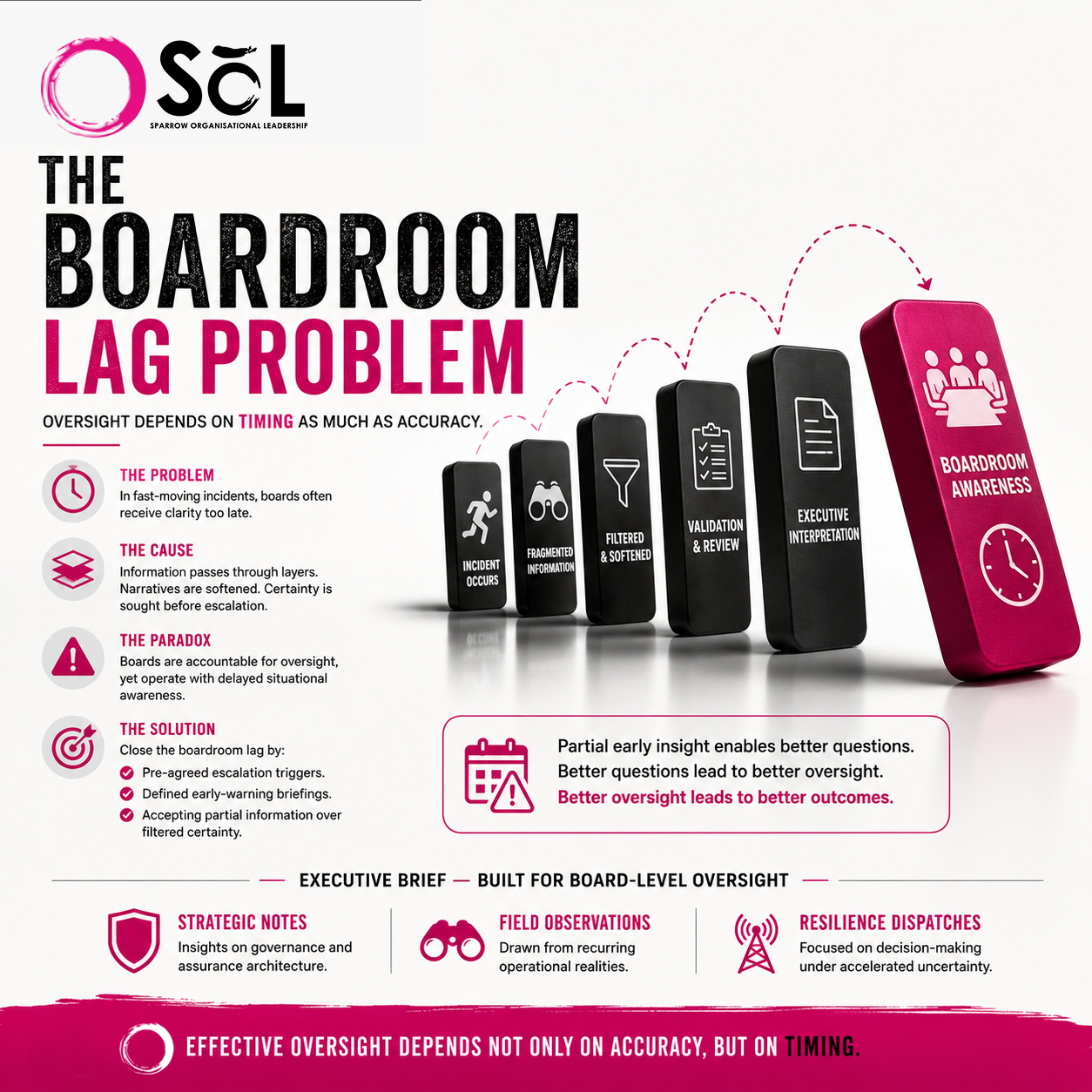
In fast-moving incidents, boards often receive clarity too late.
Operational teams move quickly.
Information is partial.
Narratives are unstable.
By the time reporting reaches the board, events may already have shifted.
This lag is rarely intentional. It is structural.
Information passes through layers of validation.
Interpretations are softened to avoid premature alarm.
Executives seek certainty before escalation.
But certainty is rarely available in early crisis stages.
The result is a paradox:
Boards are accountable for oversight, yet operate with delayed situational awareness.
Closing the boardroom lag requires:
- Pre-agreed escalation triggers.
- Defined early-warning briefings.
- Acceptance that partial information is better than filtered certainty.
Oversight depends on timing as much as accuracy.

This article is published as an Executive Brief — designed to support board-level oversight where timing, visibility, and accountability intersect.
SOL Sparrow also shares:
• Strategic Notes on governance and assurance architecture.
• Field Observations drawn from recurring operational realities.
• Resilience Dispatches focused on decision-making under accelerated uncertainty.
Effective oversight depends not only on accuracy, but on timing.
